
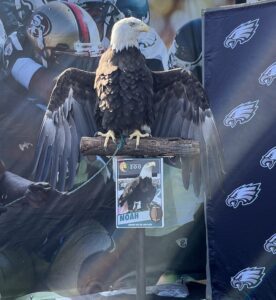
 THE LIFE OF A MASCOT
Due to their injuries, neither Noah nor Reggie performs flyovers at games. Instead, they meet guests up close on the plaza, offering photo opportunities and a chance for fans to ask questions and learn more about their species. This role requires extensive training for both the bird and the handler, as game-day environments are busy, loud, and unpredictable.
When working with our ambassador eagles, we use training methods centered on positive reinforcement. Several years ago, we made the decision to completely overhaul our bird of prey training program, focusing on individualized care and providing each animal with as much safe choice and control as possible. This approach supports a high level of welfare and allows our eagles to voluntarily participate not only in their ambassador roles, but also in their daily care.
Both Noah and Reggie are trained in a variety of behaviors as part of their routine: stepping up onto a glove so they can be moved safely, stepping onto a scale for routine health checks, and shifting into a crate for transport or while their enclosure is cleaned.
Birds of prey like eagles are predators and tend to be more solitary, so they don’t form bonds in the same way our pets might. Building trust takes time and consistency, but once established, it’s incredibly rewarding. In the wild, eagles spend much of their time hunting, so food is a strong motivator. Because our eagles can’t hunt due to their injuries, we use enrichment and positive training experiences, rewarding them with portions of their daily diet. It’s similar to giving your dog a treat for sitting—except eagles prefer fish and rats over biscuits!
As mascots, Noah and Reggie encounter far more intense environments than most ambassador animals. They’re surrounded by thousands of fans, loud noises, and constant movement. While we can’t predict everything, we work hard to ensure they’re comfortable and confident in these situations—and practice plays a huge role.
Both birds regularly come out on zoo grounds to meet visitors and experience large groups of people. The Philadelphia Eagles organization also allows us to visit Lincoln Financial Field outside of game days, giving the birds valuable exposure to the plaza and field. The more familiar they are with expected distractions—cheering, costumes, cameras, running children—the more resilient they are when unexpected situations arise.
Because eagles have incredible eyesight and lightning-fast reflexes, training can be challenging—they often see things we don’t! We spend a lot of time learning each bird’s personality, preferences, and body language. Even subtle changes in feather placement can tell us whether they’re calm, curious, nervous, or excited.
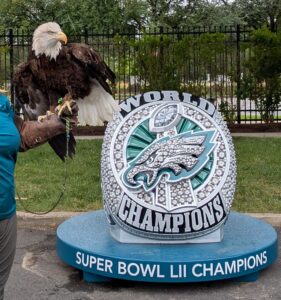 A CONSERVATION COMEBACK
With every appearance our ambassador eagles make, we share the powerful conservation success story of their species in hopes of inspiring empathy and action. About 50 years ago, the bald eagle was nearly extinct in the United States. Despite being our national bird and an iconic symbol—especially here in Philadelphia—human impacts like the pesticide DDT and habitat pollution caused their populations to plummet.
Thankfully, significant changes were made. Protective laws were enacted, behaviors shifted, and conservation efforts succeeded. Bald eagle numbers have rebounded from roughly 1,000 individuals to more than 300,000 today. In 2007, they were removed from the endangered species list—proof that humans can make meaningful, positive change.