 OUR PECCARY FAMILY GROWS (AND CHANGES)
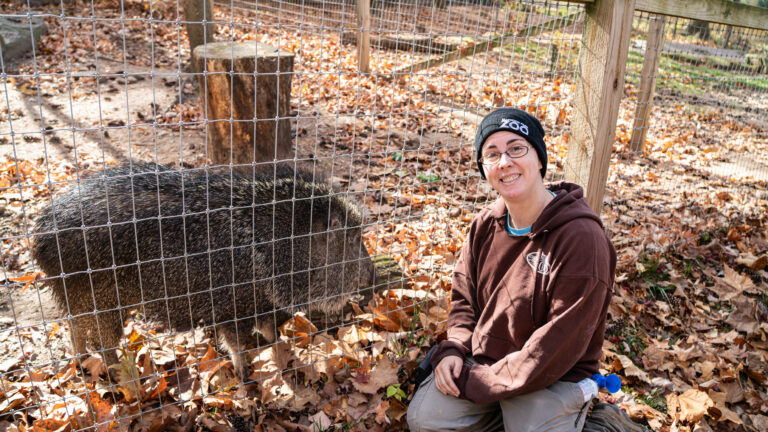
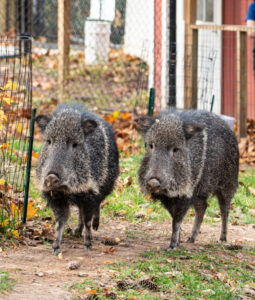
If you’ve visited the area near our giraffes and zebras, you might have noticed that our Chacoan peccary herd looks a little different these days. That’s because Elmwood Park Zoo has the exciting privilege of being a breeding facility, helping sustain the species across AZA-accredited zoos.
Our longtime parents, Yavi and Parsley, have welcomed four different sets of peclets here over the years! After making such valuable genetic contributions, they and several of their offspring have since moved to other facilities—some for new love matches, others for a well-deserved break until the Species Survival Plan (SSP) recommends their next pairing.
We’ve kept three of their daughters—Chimi, Churri, and Sage—who we hope will carry on the family line right here at EPZ.
But if you’ve stopped by recently and said, “Wait a minute… I saw four peccaries!”—you’re absolutely right.
 INTRODUCING ICHABOD
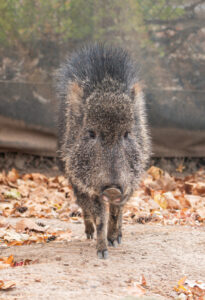
Meet Ichabod, a new male peccary from Sequoia Park Zoo in northern California! You may have already spotted him settling in with our girls. But getting to that point took careful planning, patience, and teamwork.
Introducing animals—especially social, scent-driven species like peccaries—is both an art and a science. Every species (and every individual) is different, but we follow a series of familiar steps to make sure everyone stays safe and comfortable.
 STEP 3: Opening the Doors
“Open the doors!” sounds simple—but it’s one of the most carefully planned moments in the process. Although the howdy can give us a general idea of our animals’ feelings about each other, we don’t know what’s going to happen once those doors are open and we need to be prepared. Animals could be getting along great through a barrier, then behave completely differently once the barrier disappears.
We ask a lot of questions beforehand:
– Are there hazards we should remove?
– How will we separate them if needed?
– Do we have the right tools and trained staff in position?
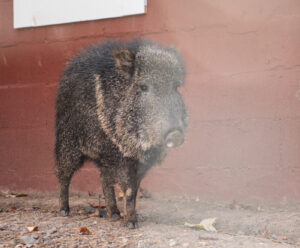
For Ichabod, there were extra factors to consider. He’s one of the oldest peccaries we’ve ever introduced, and it was also the first group introduction we have ever done here, rather than one-on-one. On top of that, he has limited eyesight, which affects how he reacts to stress. While our resident herd usually moves away when uncertain, Ichabod tends to freeze and stand his ground. Would this difference in body language impact how the girls respond to him? Would he be able to differentiate between a friend and a threat approaching him?
Although we would love to cross our fingers and hope everyone is best friends right away, it’s always best to prepare for every scenario. We had treats ready in case they separated themselves, plus noise-makers and baffle boards— which large visual shields we can use as gentle barriers if needed. Our veterinary team was on hand, ready to step in if needed. Directly beforehand, we talked through our plan with the team and assigned each person a role. Who is closing gates? Who is tossing fruit? Who is going to go in with baffle boards, and who is coordinating all of these moving parts? We made sure everyone could ask questions so there could be no uncertainty once the doors were open.
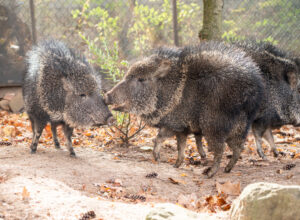 STEP 4: The Big Moment
The gates opened. The girls, more confident moving through the space, approached Ichabod. He was hesitant at first, but everyone sniffed at each other. Very quickly they were scent marking one another and following him around.
We monitored the herd for the rest of the morning, and I am pleased to say we didn’t need any of our backup plans. They have been together ever since!
There’s been a little natural social shuffling as everyone figures out their place. Chacoan peccaries are matriarchal, meaning females typically take charge. Ichabod has submitted to the older ladies, though younger Sage seems to be at the bottom rung of the social ladder for now. Chimi currently seems to be Top Lady, and has been throwing her weight around putting her sisters in their place — which can look like a lot of vocalizing and showing teeth, but is generally harmless.