
jaguar

ZOO VIEWS: What’s a Carcass Feed?
By Janine Farmer, Animal Keeper

If you’ve ever visited Trail of the Jaguar and seen one of our big cats gnawing on a deer leg or an eagle tearing into a fish, you might have wondered—what exactly is a carcass feed?

THE BASICS

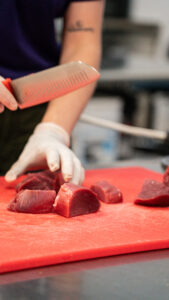
Technically, every carnivore that eats fish, rodents, or chicks is carcass fed. In the simplest terms, it means feeding an animal food that still resembles its original form—something that still “looks like” what it once was.

At Elmwood Park Zoo, our carnivore diets come in a few different forms: some are processed (like the ground meats many of our animals receive), and others arrive frozen in bulk (like rats for snakes or birds of prey). In the wild, these same animals would naturally catch and eat whole prey: snakes swallow rodents, eagles dive for fish, and jaguars hunt larger mammals.

Here in the Zoo, most of our animals were born in human care and never had to hunt. So it’s our job to make sure feeding time still gives them the mental and physical challenge they’d experience in the wild.
Finding Inspiration in the Trail of the Jaguar

When I first started working in the Trail of the Jaguar three and a half years ago, I took a special interest in improving enrichment and nutrition for our cats. Every animal here has a carefully designed diet that meets their nutritional needs—but in our field, there’s always room for growth and creativity. Sometimes, the right opportunity comes along and pushes us to evolve.

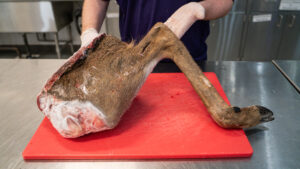
For us, that opportunity came through new relationships with local hunters and the Pennsylvania Game Commission. Deer season in Montgomery County is very productive, and while hunters often take the prime cuts for themselves, there’s usually not much use for tails, bones, or organ meat.

We began to receive deer bone donations on a regular basis, and as those increased, we realized we could completely rethink how we feed our carnivores.
Breaking Down the “Why”

Before making any big changes, we asked ourselves the important question: Why?

Why change their diets, and why feed them such recognizable parts—like deer legs, tails, or spines—right in front of guests? There’s often a stigma around the word “carcass,” even though it’s one of the most natural things for these animals.

When people hear “carcass feed,” it might sound harsh—but when you reframe it as natural feeding or whole-prey feeding, it makes perfect sense. It’s about giving animals the chance to be animals.
The Wild Connection

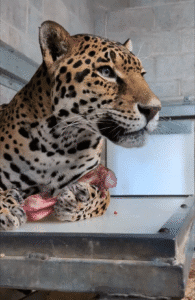
Take a jaguar, for example. In the wild, they use incredible strength to bring down prey, then rely on the strongest bite force of any cat to crunch through bones, hide, and muscle. That action helps to clean their teeth and strengthen their jaws, and they receive natural fiber and nutrients from fur, hooves, and connective tissue.

We can’t fully replicate the thrill of the hunt, but we can get close. For smaller cats like Mateo the ocelot, I might hang a whole deer tail high on a climbing structure or hide it inside a puzzle feeder. Watching him work to retrieve it, plucking every bit of hair before reaching the bone underneath, is watching him be a wild cat.

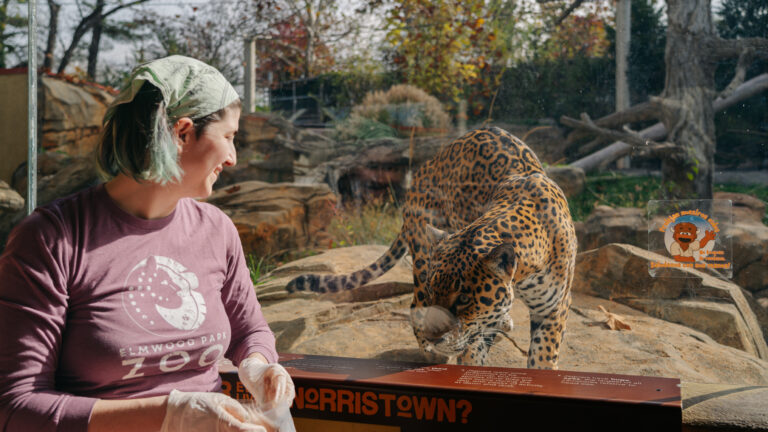
For our jaguars, we get a little more inventive. Twice a week, they receive deer bones—usually from the hock to the hoof. We’ll sometimes hide one inside a large bucket and hang it from their climbing structure. Zean, our male jaguar, then has to problem-solve, climb, jump, and wrestle to get it down. By the end, he’s worked out both physically and mentally—and that’s a huge win for his overall well-being.

The Monthly Feast

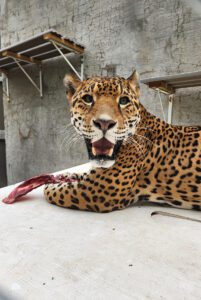
We also introduced monthly carcass feeds, where our jaguars get an entire deer leg—shoulder to hoof—instead of their usual meal. These are what we call gorge feeds: one big feast followed by a smaller meal the next day.

That mimics how big cats naturally eat in the wild—feast, rest, repeat. Watching Inka, our female jaguar, drag her meal to a quiet spot to guard it and enjoy it over time is as natural as it gets. She’s using her instincts, her muscles, and her mind—all at once. We can see recognizable changes in their behavior when they receive these feeds, such as more time grooming and resting when normally they might be patrolling.

More Than Just Cats

These benefits go beyond the big cats. Our commissary team helps prepare similar feeds for our birds of prey. If you’re lucky, you might spot our red-tailed hawk and turkey vulture, Hunter and Stan, enjoying a deer head, or our bald and golden eagles tackling a rib cage.

It might look intense, but it’s deeply enriching for them—and it’s a powerful educational moment for guests, too.

Why It Matters

At the end of the day, carcass feeds help our animals live their best, most natural lives. They get to think, move, and eat the way nature intended.

And for our visitors, seeing these behaviors up close builds appreciation for the incredible animals we care for and their wild instincts. The closer we can bring the wild to our Zoo, the stronger the connection we can create between people and the natural world.

Our goal is to foster a connection and appreciation for the animals in our care, and what better way than to watch a wide array of natural behaviors?

Diego’s big move

Diego the jaguar goes on a big move from Norristown to Memphis, Tennessee! 

Planning stages...

As the cubs got older, we as an animal care staff knew that it was only a matter of time before Inka would not tolerate their presence anymore. For humans, it might sound surprising not to want your kids around anymore, but for a solitary jaguar, it is a normal part of the maturation process. In the wild, parents will drive their offspring away once they are old enough to survive on their own. Inka was showing less and less patience with her cubs as they grew to be more than half her size, so we started practicing separation in order to get the cubs used to being alone for increasing lengths of time. 

While we were working on that, I contacted the Species Survival Plan (SSP) coordinator to let him know that we would soon need to find another zoo for Diego since Zean would not be tolerant of another adult male close by. Luna gets more leeway as a female cub! The coordinator worked on some population planning, and found that Memphis Zoo could take Diego and another young female, (Filomena) so we started working on plans for that move.

The first step was getting Diego used to the travel crate. Crates for big cat species are extremely durable as cats are very strong! We had to bring the crate up to Trail of the Jaguar and set it up in the night housing area. It is strapped to a special door that is used for crating and transfer. Once that was in place, keeper staff began training Diego to enter the crate voluntarily for treats. We even practiced opening and shutting the crate door with him inside, and making some banging noises on it so he would be used to those sounds. As expected, he picked up really quickly as he is very motivated to train, so before we knew it, we were making the final plans to move him to Memphis! We decided to transport him by vehicle rather than air shipment, so keeper Mel and I got ready for a road trip to Memphis!

On the day of the move...

Late in the afternoon, we made sure to keep everything normal on routine and asked Diego to crate. This time, we kept the door shut instead of opening it. It stayed shut,and a crew of staff picked up the crate and carried it out to our transport vehicle (one of our Zoo-on-Wheels vehicles). With a wave goodbye from staff, we hit the road for an overnight trip. Diego traveled better than we could have hoped for! He was calm and looking around, (even peeking out the back window of the van like a dog for portions of the trip) and even settled down for a nap a few times. He actually slept more than we did on that journey!

Once we arrived in Memphis the next morning, the keeper staff at Diego’s new home greeted us and we quickly got his travel crate mounted to the quarantine enclosure at Memphis and opened the door. When Filomena (his new female companion) arrived at Memphis, she took two hours to come out of her crate but I had a feeling that Diego would be bolder! He was… and came out of his crate after only a couple of minutes of peeking around, and then got busy smelling and exploring his new space. Since we needed to let Diego settle in, we spent some time walking around Memphis Zoo and snapped a picture of his new habitat at Memphis. Mel got to visit with some staff she used to work with since she used to be a keeper there in the cat exhibit, so she knew he would be going to good hands.

Of course, we will miss him but we are excited to have Diego get paired up with Filomena and hope to hear about his cubs in the not too distant future! 

Written by Former General Curator  Marina Haynes

Elmwood Park Zoo joins with outside forces for jaguar surgery

Elmwood Park Zoo’s adult female jaguar, Inka, recently underwent dental surgery to help remove a badly damaged canine tooth. Elmwood Park Zoo Veterinarian Dr. Michele Goodman recruited the help of veterinary dental specialist Dr. John Lewis of NorthStar Vets, veterinary anesthesiologist Dr. Andrea Caniglia of Veterinary Dental Specialists, and Brandywine Zoo Veterinarian Dr. Erica Miller to help with Inka’s procedure. The zoo was also fortunate to have the support of Jeff Scharff, District Sales Manager of Planmed, Inc., who provided the Verity® Cone Beam Computed Tomography Scanner to evaluate Inka’s teeth, and Dr. Elizabeth McMurtrie of Spring House Animal Hospital, who loaned the zoo a portable blood analyzer so that Inka could be carefully monitored while under anesthesia.

Inka's surgery team post-procedure

Thanks to training administered by Elmwood Park Zoo Animal Keeper Kate Olsen and Assistant Curator Laura Fournier, Inka voluntarily received an injection of sedative.  Within 10 minutes of the injection, Inka was ready for her procedure. Her head was placed inside the scanner and images were obtained of her skull and mouth. After reviewing the scans, the veterinary team confirmed that Inka’s upper right canine tooth was beyond repair and needed to be removed to protect her health.

With the scans complete, general anesthesia was induced. Inka was intubated and hooked up to monitoring equipment. In addition to routine monitoring equipment, Dr. Caniglia placed an arterial catheter to continuously monitor Inka’s blood pressure. Inka also received intravenous fluids and supplemental medications throughout the procedure. Spring House Animal Hospital used their portable blood analyzer to sample Inka’s electrolyte and blood gas levels every 30 minutes to ensure that the big cat was doing well under anesthesia. While assisting with anesthetic monitoring, Elmwood Park Zoo Veterinary Technicians Holly Brown and Kourtney Conti collected blood samples for routine evaluation of liver, kidney and heart function.

Dental extractions are no easy feat; they require doctors to employ both skill and patience to preserve the tissues and structures around the extracted tooth. Elmwood Park Zoo recently obtained a state-of-the-art dental machine that Dr. Lewis used for the procedure. Following the successful extraction of the damaged canine tooth, Dr. Lewis sutured the soft tissues over the extraction site. Another essential part of dental extractions is managing the patient’s pain. Dr. Lewis used a series of nerve blocks to alleviate pain at the extraction site and he placed Inka on two pain medications to maintain her comfort following surgery. 

Overall Inka’s exam and dental surgery took just under five hours. Thanks to the diligent patient care and monitoring that Inka received by the talented group of experts who assembled for her procedure, she is doing extremely well. The surgical site is expected to heal over the next two to three weeks, after which Inka will be able to return to her normal diet.