By Laura Soder, Director of Ambassador Animal Engagement
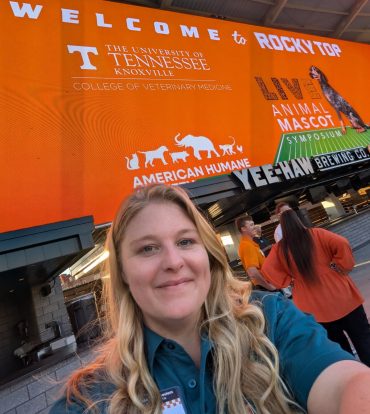
Earlier this summer, Elmwood Park Zoo was invited to attend the Live Animal Mascot Symposium in Knoxville, Tennessee.
LEARNING FROM THE LIVE MASCOT WORLD
Hosted by the University of Tennessee College of Veterinary Medicine and sponsored by American Humane Society, this exclusive gathering brought together representatives from institutions across the country that care for and celebrate live animal mascots. The goal was to foster collaboration, exchange ideas, and establish best practice guidelines that prioritize the highest standards of animal welfare, while also enhancing fan engagement and institutional pride.
As an attendee, I was thrilled to meet other professionals and learn about their programs, while also having the opportunity to share the growth, successes, and challenges we’ve experienced over the years in such a niche field.
As the Director of Ambassador Animal Engagement, I oversee the care, training, and presentation of our ambassador animals, including our mascot partnership programs. We currently house Stella the Owl, Temple University’s live mascot, as well as Noah and Reggie, the live mascots for the Philadelphia Eagles.
TAKING A STEP BACK TO MOVE FORWARD
Stella began as Temple’s mascot in 2013, followed closely by Noah, who started with the Eagles in 2014. Our current training and care teams inherited both of these partnerships, along with expectations and obligations that had been established years earlier. But there was a great need for change, specifically when it came to promoting the best animal welfare.
In the early years of their ambassador roles, Stella and Noah did not have much choice when it came to participating or control over their environment. This resulted in more frequent displays of stress behaviors while out in public and a generally aversive attitude toward staff. Being in front of such a large audience, it was imperative that we put our best foot forward as an organization and that meant taking a step back to look at what was in the best interest of the animals.
The zoo and animal training worlds are always changing and growing as we learn more. With time, staff changes, and a culture shift toward more transparency, we were able to focus on improving things for both our animals and the guest experience.
In 2018, we decided to completely revamp how we work with our ambassador birds. We brought in a consultant to help teach our staff how to use positive reinforcement techniques with birds of prey. We pulled all of our ambassador birds off programs and hit the reset button until we made significant progress in their training, incorporating more choice and control.
GIVING OUR MASCOTS A CHOICE
What does that look like for our live mascots? Our birds now voluntarily shift out of their enclosures for cleaning, programs, and medical procedures, so we generally do not go into their space for any reason outside of an emergency. This was the first step in giving them more agency over their day-to-day lives. Now that it’s well established, it also signals to us that they are actively interested and willing to participate. It’s them saying, “Yes, I want to come out to train!”
They also voluntarily hop onto a scale for weights, crate themselves from their enclosures, and step up to the glove. We have even trained voluntary hooding for equipment placement and removal in Reggie’s case, because we found out pretty quickly that he likes to destroy his equipment if left to his own devices!
With Noah and Stella, we had to overcome a lot of negative history, or behavioral baggage, because they did not have many degrees of freedom in the early days of their handling. What is so rewarding for us as trainers, after so much time, hard work, and patience, is seeing that eventual shift happen. Instead of moving away, they eagerly come over. They offer new behaviors, their confidence and resilience increase, and they look to us with eagerness rather than aversion. They know that when they come out for training or appearances, they will be heavily reinforced, and they can trust us as a consistent and safe presence.
We use their diet to reward them, along with other secondary reinforcers like misting and sunning opportunities. We weigh them regularly to make sure they are in a good range for optimal health and motivation. This changes seasonally, and we are always reevaluating to make sure we are managing them at the highest weight possible.
THE REGGIE EFFECT
At the same time as the training overhaul, we brought Reggie on as a new ambassador. He came to us as a clean slate, with no prior experience being trained or handled. We were able to shape his training from the beginning, which was exciting and a great learning experience, but also intimidating.
That experience has truly made us stronger trainers. Some may be familiar with the phrase, “A smooth sea never made a skilled sailor.” That’s Reggie’s mantra. And while we generally use the same training techniques with all three birds, they each have very different personalities, and we have to take that into account.
TRAINING THE HUMANS, TOO
We’re really happy with where our program is now, and both Temple and the Eagles have been extremely supportive. With change, there are always challenges, so there was a period when we were training the humans too, making sure they understood our new requirements and reworking what it looks like when these birds are out at events.
But we’ve found that transparency and open communication go a long way, both with the organizations and the fans. We can’t keep the birds in a bubble, and these events can be very chaotic and overstimulating. So we interpret each bird’s body language in real time and explain how the trainer works with the bird to help them feel safe and comfortable, or recover and reset if something spooky happens.
MORE THAN A MASCOT
This also allows us to really focus on our conservation messaging, which is an important part of the zoo’s mission. In the past, Stella and Noah spent a lot of time on the sidelines at games, sometimes making a screen appearance but often getting lost in all the commotion. Now, we focus more on meeting guests on the concourse before the game, where we can field questions, talk about their natural history and personal stories, and build empathy.
Overall, we’ve seen an incredible shift in our birds, in how they react to us, how they respond to their surroundings, and the positive behaviors we see when they’re out at events. They are eager and excited in their roles as ambassadors and mascots. That not only makes us as trainers excited to present them, but also allows us to create the best possible experience for the fans.
I was very thankful to be part of this event, to talk with other organizations, and to learn how we can continue improving the welfare and lives of the animals in these programs. I hope EPZ can be involved in future collaborations in the live mascot world because when we learn better, we do better, and these animals deserve it.